Your server, reachable from anywhere.
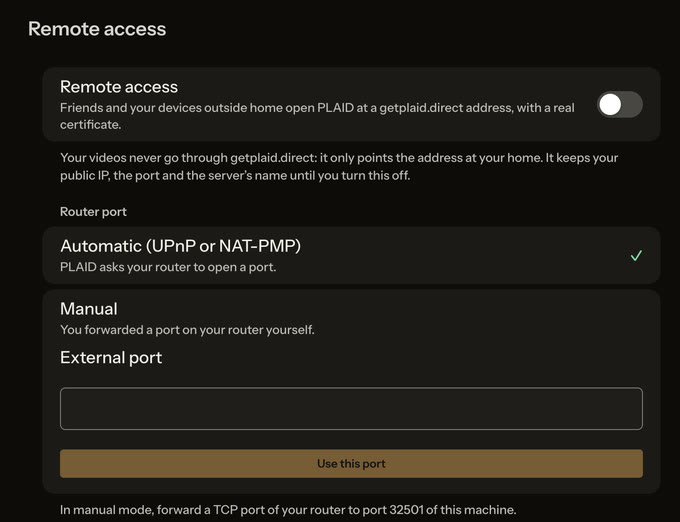
Turn it on in Settings → Remote access. Your server gets an address with a real certificate, and your videos never pass through us.
Open a port.
PLAID asks your router to open one with UPnP or NAT-PMP. If your router can’t, choose Manual and forward a TCP port to port 32501 of the PLAID machine.
32501 is PLAID’s HTTPS port (PLAID_TLS_PORT).
Get a name.
living-room-k3x7qa.getplaid.direct
PLAID registers with getplaid.direct, which points that name at your public IP and follows it when it changes. The server checks in every 15 minutes.
Get a certificate.
PLAID gets a Let’s Encrypt certificate for that name. The challenge goes through getplaid.direct’s DNS, so no port 80 is needed and the private key never leaves your server.
Send the link.
https://getplaid.direct/k3x7qa
The short link redirects to your server, so friends only need one. Before you send it, getplaid.direct checks from outside that your server answers.
Paths
Video never goes through getplaid.direct
The link redirects once, DNS answers with your home IP, and from then on the device talks to your server directly. There is no relay: that's also why, behind CGNAT, you need a VPN like Tailscale instead.
- Your videosFrom your server to your friend’s screen. Never through us.
- The addressgetplaid.direct answers DNS with your public IP.
- The certificateLet’s Encrypt checks a DNS record PLAID sets. The key stays home.
Turn it off.
Switch remote access off in the same settings: getplaid.direct deletes your server’s records at once. A server it hasn’t heard from in 30 days is removed too.
Caveats
When it can’t work
- Behind CGNAT
- Some fibre and mobile providers share one public IP between homes, so no port can be opened. Use a VPN such as Tailscale instead.
- In Docker
- UPnP can’t see your router from Docker’s default network. Use
network_mode: host, or choose Manual and publish32501:32501. - Your own setup
- Prefer your own domain, reverse proxy or tunnel? PLAID works behind them, with getplaid.direct left off. Behind a reverse proxy.