Your movies and shows, on your own server.
PLAID indexes the films and series on your disks and streams them to every screen in the house. No central account, no subscription. Watch alone, or together.
Early development. The server, the web app and the Apple TV app work today. Sharing and Plaid Party are designed, not built. Where we are.

One command, before anyone arrives.
PLAID is a single Go binary with SQLite and FFmpeg. On Ubuntu or Debian, the script installs a system service that starts on boot. No Docker needed.
curl -fsSL https://raw.githubusercontent.com/gh-prim/plaid/main/packaging/install.sh | sudo bashamd64 or arm64: a Raspberry Pi 4 or 5 with a 64-bit OS is enough.
Every way to installAn account that lives on your server.
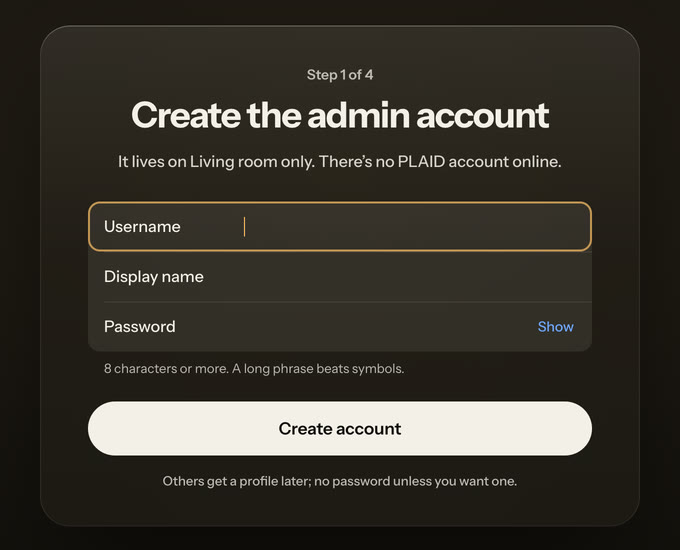
The first visit creates the admin account, on your machine. There’s no PLAID account online, and nothing to sign up for with us.
The link is sent.
Turn on remote access and your server gets an address with a real certificate. Friends open one link:
https://getplaid.direct/k3x7qa
Your videos go straight from your server to them. getplaid.direct only answers DNS.
How remote access worksOn the TV, it’s an app.
The Apple TV app finds the server on your network, pairs with a code, and plays with the same look and flow as the web. In English or French, per profile.
Everyone lands on the same frame.
Plaid Party is the feature PLAID is built around: one link, and play, pause and seek reach everyone at once, each on the stream that suits their screen. It’s designed, not built yet.
Plaid PartyNosferatu
1:12:4821m left
- AAdaApple TV · 4K Direct Play
- SSamiPad · 1080p
- JJoPhone, on the train · 720p
- LLouLaptop · Direct Play
Credits: two developers and a couch.
PLAID is MIT licensed and built in the open. Every feature starts as a written intent, then a spec, then a plan, all on GitHub.